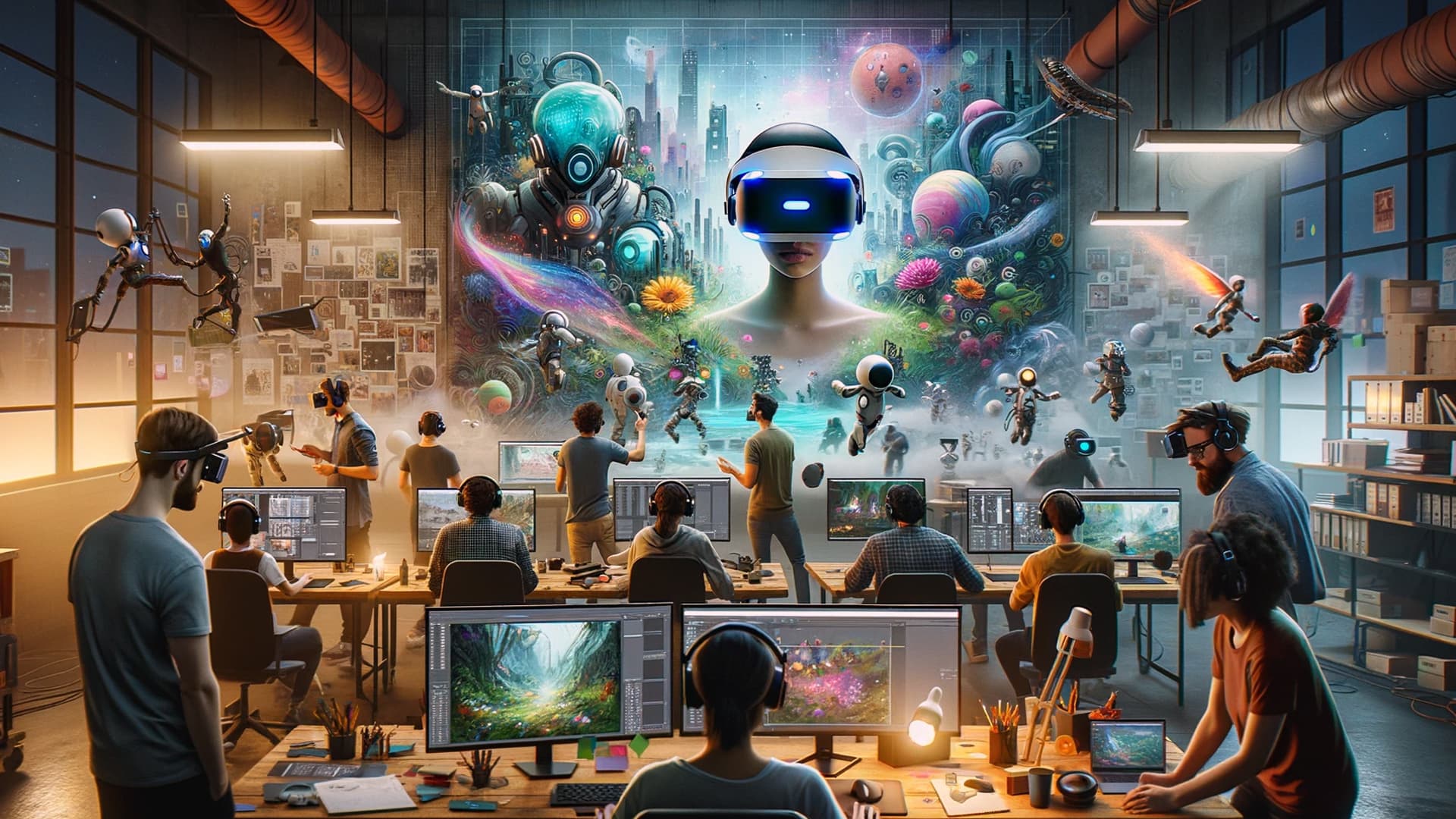
What is Generative AI and how can it be used in Virtual Reality Experiences?
Generative AI refers to a class of artificial intelligence technologies that can generate new content, such as text, images, audio, and other media, based on the patterns and...
Generative AI in Virtual Reality and 3D Content Creation
Generative AI refers to a class of artificial intelligence technologies that can generate new content—such as text, images, audio, and other media—based on patterns learned from vast amounts of training data. This capability is particularly powerful because it enables the creation of novel and creative outputs with minimal direct human intervention beyond initial training and setup.
Applications of Generative AI in Virtual Reality (VR)
In the context of Virtual Reality, Generative AI can enhance experiences in numerous ways:
Content Creation
Generative AI can be used to create vast, detailed virtual environments and assets more efficiently than manual methods. This includes generating:
- Realistic landscapes
- Urban environments
- Fantastical or fictional worlds
This significantly reduces the time and cost required for manual 3D content production.
Dynamic Narratives
AI can generate adaptive storylines or dialogues in real time, allowing VR experiences to become highly personalized. Each user interaction can influence the narrative direction, resulting in unique and evolving story experiences.
Interactive Characters
Generative AI enables virtual characters that can:
- Respond intelligently to user input
- Simulate emotions and personality traits
- Evolve over time based on interaction history
This increases immersion and realism in VR environments.
Soundscapes
AI-generated audio can dynamically adapt based on user location and actions within a virtual world. This includes:
- Adaptive background music
- Context-sensitive sound effects
- Realistic environmental audio
Simulation and Training
In education and training scenarios, Generative AI can create adaptive simulations tailored to the learner’s level. For example:
- Medical training scenarios with dynamic complications
- Industrial safety simulations
- Interactive learning environments that adjust difficulty in real time
Accessibility Features
Generative AI can improve accessibility in VR by enabling:
- Real-time language translation
- Automated subtitles
- Descriptive audio for visually impaired users
Generative AI for 3D Model Creation
Generative AI can also be used to create and enhance 3D models across industries such as gaming, film, architecture, and virtual reality.
Automated 3D Modeling
AI models trained on large datasets of 3D assets can generate new models from:
- Text prompts
- Sketches
- Basic geometric inputs
This enables rapid prototyping and asset creation.
Enhancing Detail and Texture
AI can upscale and refine low-resolution models by adding:
- High-resolution textures
- Surface details
- Material realism
This improves visual fidelity while reducing manual workload.
Style Transfer
Style transfer techniques allow AI to apply aesthetic styles across 3D models, such as:
- Architectural styles (e.g., Gothic, modern, futuristic)
- Material and texture variations
- Artistic transformations across assets
Parameter-Based Modeling
Generative AI enables dynamic models driven by parameters such as:
- Size and scale
- Color and material properties
- Structural variations
This is particularly useful in architecture and product design workflows.
Animation and Rigging
AI can assist in:
- Automatic skeletal rigging
- Motion generation
- Base animation creation for characters and objects
This reduces the complexity and time required for animation pipelines.
Potential Challenges
While Generative AI offers significant benefits, it also introduces challenges:
Ethical Considerations
- Privacy concerns
- Psychological effects of immersive AI-generated environments
- Risk of misleading or harmful content generation
Technical Demands
- High computational requirements
- Increased infrastructure costs
- Hardware limitations for real-time processing
Quality Control
- Inconsistent output quality
- Need for human oversight and validation
- Potential lack of precision in complex scenarios
The Future of Generative AI in VR
Generative AI is expected to become a core component of next-generation Virtual Reality systems. As these technologies mature, we can expect:
- More intelligent and responsive environments
- Fully AI-generated immersive worlds
- Seamless integration between real-time AI and spatial computing systems
This convergence will significantly expand the possibilities of interactive digital experiences.
We Use Generative AI Practically on a Daily Basis
At Gerald Ferreira, we are dedicated to harnessing innovative technologies to develop state-of-the-art virtual reality experiences. Generative AI is a core part of our development process and significantly enhances our creative and technical capabilities.
We use Generative AI to:
- Generate immersive VR environments and content
- Enhance interaction with intelligent virtual avatars
- Extract and structure company-specific data for conversational AI systems
- Simplify and optimize complex 3D models for VR and AR applications
This allows us to build more efficient, scalable, and engaging immersive solutions tailored to diverse business needs.
Let’s Build the Future Together
If you’ve recognized the potential of Generative AI for your business or need assistance implementing it, we invite you to reach out.
At Gerald Ferreira, we specialize in integrating advanced technologies such as Generative AI into real-world business environments.
Let’s explore how we can use this technology to enhance your operations, products, and customer experiences.
Author: Gerald Ferreira